

CHF 260–510 million a year,
fighting corrosion.
Corrosion drives an estimated CHF 260–510 million every year in the Swiss road network — bridge deck repairs, parapet replacement, retaining wall refurbishment. That is over half of all structure maintenance. Mountain pass infrastructure under de-icing salt is the highest-cost failure mode in European road maintenance.
A salt cycle
that never resets.
From November through March, Alpine motorways and bridge decks receive intensive de-icing salt treatment. The chloride builds up in the concrete cover. The steel inside passivates the day the pour cures, then starts a chloride-ingress timeline that ends in spalling and partial deck replacement. The cycle repeats roughly every decade — sometimes faster on the highest-traffic bridges.
GFRP does not enter the chloride reaction. The concrete deck still needs its structural cover, but no longer needs to keep the reinforcement away from salt. Lifecycle modelling typically extends design service life by up to two times — measured at the level of the cycle, not the bar.
The closed loop
GFRP breaks.
Four phases of every year in the life of an Alpine bridge deck. The cycle compounds — each winter adds to the chloride load already in the concrete, accelerating the next degradation step.
Every step still happens to the concrete — but the reinforcement is no longer part of the chemistry. The maintenance cycle on a GFRP deck is a concrete cycle, not a steel-corrosion cycle.
Where GFRP earns its place
in Alpine projects.
Four element families that account for most of our Alpine and de-icing-salt shipping list. Each one a different cost line on the federal road budget.
- 01Bridge deck slabs
Highest cost line in Alpine maintenance. GFRP top mat with steel bottom mat is the most common detail; full-GFRP decks specified on new builds.
- 02Parapets & barriers
Direct salt-spray plus impact loading. GFRP enables embedded sensors — antennas and structural-health monitoring without the rebar breaking the signal.
- 03Tunnel portals
Salt-laden runoff from the deck above onto the portal structure below. GFRP eliminates a chronic refurbishment cycle.
- 04Retaining walls
Salt accumulates against the wall face. An independent assessment documented the inspection problem on external rebar — GFRP removes it.
For the design office.
Six notes that come up in almost every Alpine cooperation. None of them invalidate the codes — they direct the engineer toward GFRP-appropriate detailing for de-icing-salt exposure.
- Cover
- EN 1992 minimum for exposure class XF4 / XD3 retained. GFRP does not reduce cover requirements.
- Bond β
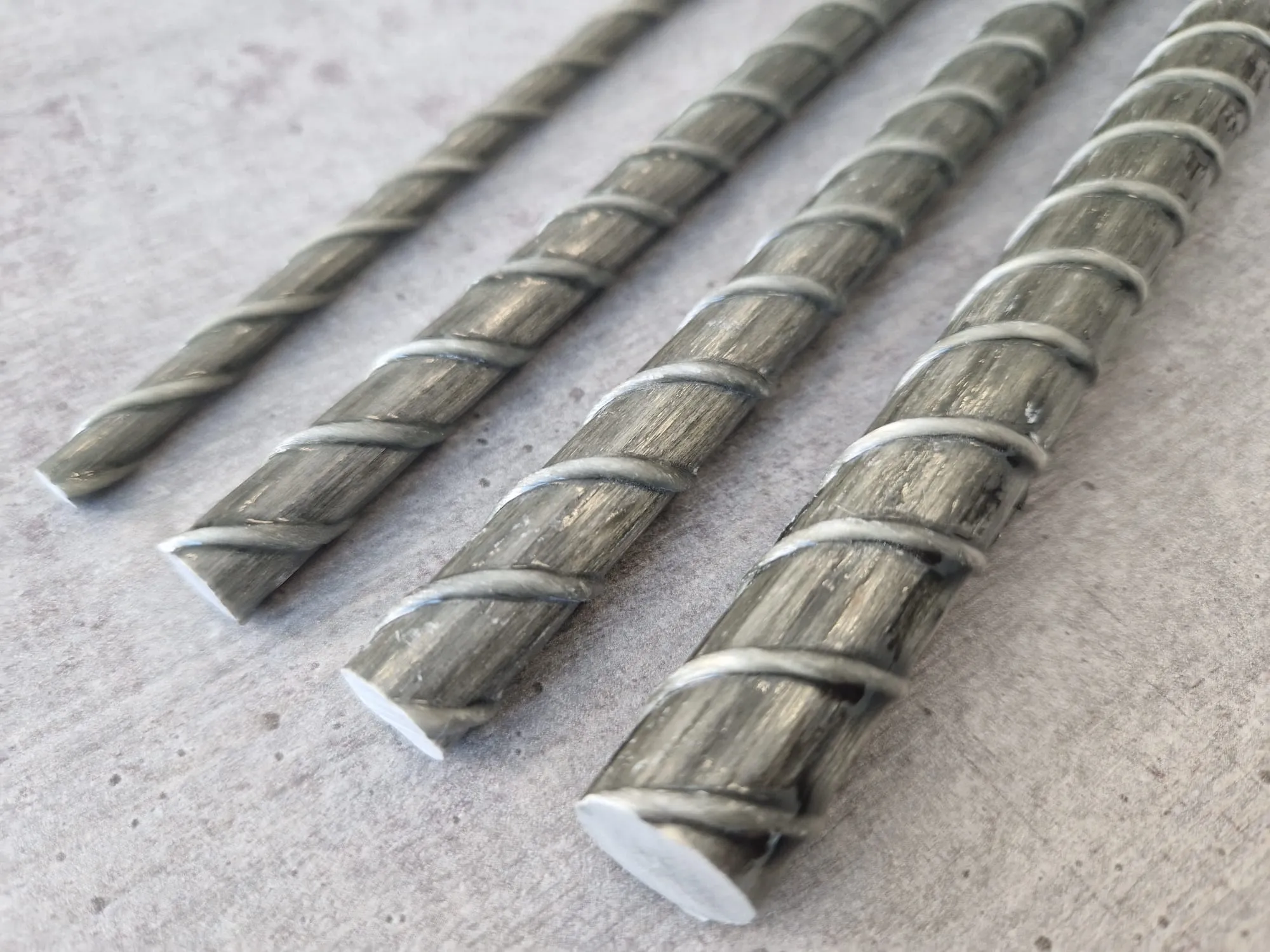
- ≈ 1.0 with sand-coated + helical-wrap GFRP per ETA 23/0523 (EAD 260023-00-0301).
- Bridge decks
- Hybrid section is standard: GFRP top mat (chloride zone), steel bottom mat (ductility reserve under service load).
- Thermal
- GFRP carries no corrosion, so freeze-thaw cycling drives none of the rust-expansion spalling that ends salted steel-reinforced concrete.
- Code references
- ACI 440.11-22 + fib MC 2020 §17.5 + ISO 10406-1. Project-specific assessment per ETA 23/0523 (EAD 260023-00-0301).
- Pilot pour
- We run the design-office workshop and the post-pour review.
What Alpine engineers ask first.
- De-icing salt — applied 30 to 80 days per year on most Alpine motorway networks — drives chloride ions through the concrete cover. Once chlorides reach the steel surface at a threshold of about 0.4% by mass of cement, the passive layer breaks down and chloride-induced corrosion begins. The corrosion product is ~6× the volume of the parent steel, which spalls the cover. Typical Alpine bridge decks reach this state in 15 to 25 years.
- Switzerland alone faces an estimated CHF 260–510 million per year in corrosion-driven repair of its road structures — over half of all structure maintenance. That figure excludes the carbon cost of the repair concrete and the closure-time opportunity cost. Across the Alpine arc (FR, IT, AT, CH, DE) the total runs into the billions of euros per year. GFRP-reinforced Alpine elements eliminate this maintenance chain entirely.
- Yes — ETA 23/0523 (EAD 260023-00-0301) covers exposure classes XD3 and XF4 directly. Hybrid sections (GFRP top mat + steel bottom) are the most common Alpine specification because they retain ductility for seismic provisions while eliminating the chloride-exposed reinforcement. Composite Group has supplied GFRP for retaining walls, parapets, tunnel portals and motorway slabs across the Central European Alpine corridor.
- Yes. Avalanche galleries and tunnel portals see the heaviest de-icing salt exposure on the network because they collect drainage runoff from above. GFRP eliminates the rust-jacking failure mode that ends most portal structures at year 20–25. Tunnel-lining GFRP is also non-magnetic — relevant where rail signalling or 5G transmission runs adjacent to the structure.

