

GFRP,
specified.
Reinforcement for structures where corrosion drives lifecycle cost. The reference material we send to engineering offices specifying GFRP for the first time — and the documentation our regular cooperation partners draw on every week.
Reinforcement for
the failure modes
steel can't handle.
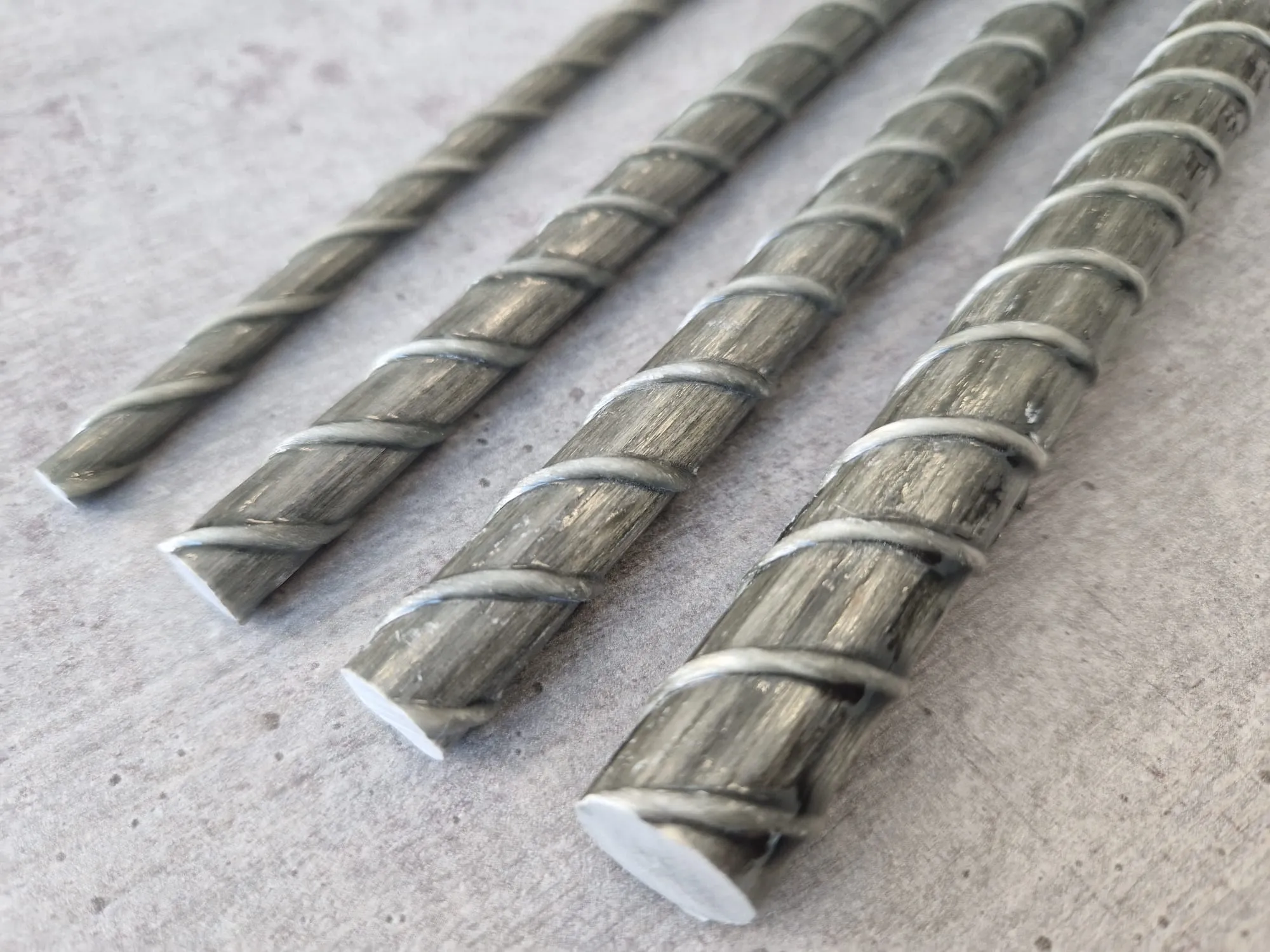
Glass fibre reinforced polymer — bars of continuous glass fibres bound in resin — replaces steel rebar in concrete. It is specified where chloride attack, chemical exposure, or radio interference end the steel before the structure should be retired.
It isn't a universal replacement for steel. It's a focused choice. Used for the right job — corrosion, lifecycle cost, or where signals and sensors matter — it changes what concrete can do.
The codes engineers
are already working from.
GFRP rebar has a mature international codes base — ACI, CSA, fib, ISO and ETA — even where the local code has not yet caught up. We supply the reference material that goes with each.
- EU EUROPE
- ETA 23/0523 · EAD 260023-00-0301
- fib Model Code 2020 — FRP sections
- Eurocode 2 Annex R (draft)
- CNR-DT 203 · IT
- AFGC guideline · FR
- US USA
- ACI CODE 440.11-22
- ACI 440.1R-15 — design guide
- ACI 440.6-08/17 — specification
- ACI 440.3R-12 — test methods
- CA CANADA
- CSA S806 — design & construction
- CSA S807 — FRP specification
- ISO ISO
- ISO 10406-1 — test methods
- ISO/DIS 14484 — performance
- JP JAPAN
- JSCE 1997 — design & construction
A consolidated reference index, with current edition numbers and where to obtain each document, is available on request.

Same problem,
a different design.
Six differences between steel and GFRP that change how you detail a section. None of them break the codes — they just point to different details.
What we tell engineers
up front.
We respect engineering offices that ask hard questions, so we name what GFRP is not before what it is. Six limitations every cooperation begins with — sourced from an independent engineering assessment.
- 01Linear-elastic to failure
GFRP does not yield. Members should be designed with a higher reserve of strength, and confinement (steel stirrups or spirals) is used to raise the concrete's ultimate compressive strain.
- 02Lower fatigue resistance than steel
Not ideal as the only reinforcement under high-cycle loads. Details should avoid stress concentrations at sharp profile changes.
- 03Fire behaviour limited by the resin
The resin softens above its glass-transition temperature. Fine for buried and concrete-encased use; not for exposed structural parts without extra measures.
- 04Limited bar-shape complexity
Bendable up to Ø 12 mm. Continuous-fibre production cannot form intricate curved geometries; custom shapes are co-engineered ahead of order.
- 05UV-sensitive during storage
Bars must be protected from direct UV exposure in transit and on-site storage. After pour, concrete cover handles this.
- 06Not a universal replacement
GFRP is a focused choice for environments where corrosion drives the lifecycle cost. For that job it's the right choice; outside it, steel may still be better.
Hybrid reinforced structures can be the best of both worlds — steel and GFRP each doing the job it's best at.
Built to test it,
not commit.
The first cooperation is a structured pilot, not a commitment. The goal is to put GFRP on one element of your project and see what it does. The decision to scale comes after the pour.
- 01Technical workshop
Half-day with your design office. We bring the design rules, the code references and the detail templates. You bring the structure you want to evaluate.
- 02Sample & spec package
Physical material samples (Ø 6 / 8 / 12 mm), a bill-of-materials comparison versus steel, and a draft specification clause for inclusion in tender documents.
- 03Pilot pour
One documented pour in your project — bridge deck section, parapet, drainage channel, or retaining wall. Installation feedback, post-pour review, scaling roadmap for the next elements.
Suitable first-pilot elements: bridge deck sections · parapets · drainage channels · retaining walls · roadside slabs.
The reference shelf.
The documents we attach to most engineering enquiries. Download what you need now — the rest comes with the workshop in step one of the pilot.
- ETA · EUETA 23/0523European Technical Assessment
First ETA for GFRP rebar in Europe. The legal cover for CE-marked submissions.
PDF · 2.1 MB Download - EPDEN 15804 +A2Environmental Product Declaration
EuCIA-verified. Cradle-to-gate carbon and the full lifecycle dataset.
PDF · 980 KB Download - BIMIFC · RevitBIM family
Generic Revit family across the full diameter range. IFC export on request.
ZIP · 12 MB Download - DESIGN GUIDECG-EG-0026Design guidance for GFRP
Composite Group's detail templates: confinement, anchorage, lap splices.
PDF · 4.6 MB Download - MILL CERTper shipmentMill test certificate · sample
Tensile, modulus and bond test results for a representative production batch.
PDF · 320 KB Download - STANDARDS INDEXACI · CSA · fib · ISOInternational code index
A consolidated index of every code referenced on this page, with current editions.
PDF · 240 KB Download
Before we send specifications,
three questions about the structure.
Environment, expected service life, and which approval authority you are submitting to. Once we have those, we send the relevant ETA documentation, a mill test certificate sample, and the technical datasheet for the diameters you need. Typical reply within one working day.
+421 917 592 255

