
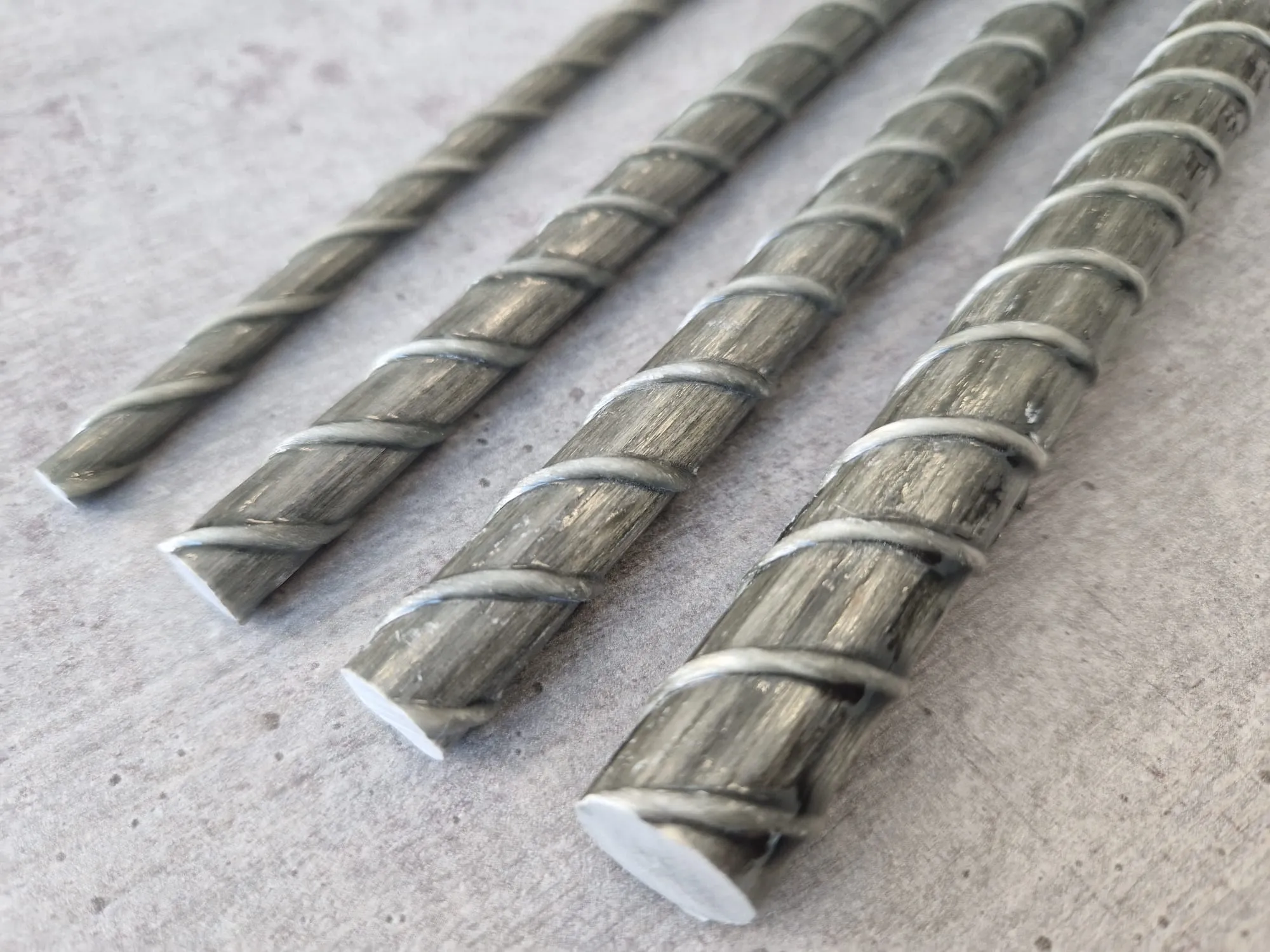
Up to 70 %
less carbon.
GFRP rebar reduces the embodied carbon of concrete reinforcement by up to seventy percent compared with equivalent steel rebar. Independently substantiated under EuCIA methodology, on record under EN 15804 +A2, and made auditable through our Environmental Product Declaration.
The advantage is not
in the bar — it is
in the decades that follow.
GFRP rebar takes more energy per metre to produce than steel rebar — for a few minutes after manufacture, this looks like a worse material. Then concrete starts curing, eighty years start counting, and steel rebar starts its maintenance cycle. From there onward, GFRP is the lower-carbon choice by a wide margin.
The numbers below are not promotional. They are extracted from the EPD, audited under EuCIA methodology, and consistent with an independent engineering assessment. We treat them as material properties — the same way we treat tensile strength.
The math, set out
side by side.
Two bars, indexed against the same functional unit: one metre of equivalent reinforcement, over the design life of the structure. Steel is the baseline at 100. GFRP comes in at roughly 30.
Illustrative percentages relative to a steel baseline of 100. Values normalised across an 80-year functional unit. The figures are consistent with EuCIA verification but not project-specific; for project-specific lifecycle assessment we run a custom model in step one of the cooperation.
EN 15804 +A2,
EuCIA-verified.
Cradle-to-gate carbon plus a full lifecycle dataset, made auditable under European methodology. Available on request for LEED, BREEAM and DGNB submissions.
- MethodologyEN 15804 +A2 — Sustainability of construction works. Lifecycle assessment.
- VerificationEuCIA — European Composites Industry Association. Independent third-party audit.
- ScopeCradle-to-gate carbon (modules A1–A3); supplementary modules A4 transport, B1–B5 use phase, C disposal.
- Functional unit1 metre of equivalent reinforcement over 80 years of design service life.
- Reference documentEPD-CG-26-001 — Composite Group GFRP rebar, valid 2026–2031.
- Rating systemsLEED v4.1 (MR), BREEAM (Mat 01/03/Wst 02), DGNB (ENV 1.1/1.2 · TEC 1.6).

Six milestones,
all checkable on record.
- 2021
Composite Group founded with a sustainability mandate: build a low-carbon alternative to steel rebar, at industrial volume.
- 2022
First EPD methodology workshop. EuCIA verification process initiated alongside the TSÚS approval.
- 2023
EPD EN 15804 +A2 issued. Cradle-to-gate dataset published; available for LEED, BREEAM and DGNB submissions.
- 2024
Selected by Microsoft, Capgemini & Bouygues — Elemental Impact Build Better Innovation Challenge. ETA 23/0523 issued.
- 2025
Jizan flood channel completes — 21.3 km, 91 % less CO₂ vs steel-equivalent. Independent ACI documentation.
- 2026
Capacity expansion underway. EuCIA member contribution to EU composites policy on embodied-carbon procurement.
We treat carbon as a material property, not a marketing theme. The figures are checkable against the source documentation we will gladly send.
What we don't claim.
Three things we are sometimes asked to claim and don't. Naming them is part of how the other numbers on this page stay credible.
- 01Not lower per-kilogram than steel.
GFRP rebar takes more energy per metre to produce than steel rebar. The advantage is measured over the design life of the structure, not at the factory gate.
- 02Not a substitute for low-cement concrete.
Our carbon claim is the reinforcement contribution. Reducing the concrete cement content matters more in absolute terms — we are an addition to that toolkit, not a replacement.
- 03Not climate-positive — climate-validated.
We do not claim GFRP captures carbon. We claim it avoids the carbon of the maintenance cycle that steel reinforcement requires. The avoided-emissions accounting is standard EN 15804 +A2.

